SKT is taking on the challenge of “AI for All”, working to connect AI to the many areas of everyday life where the public needs it most. In this column, SKT AI CIC Head Yoo Kyung-sang introduces SKT’s competitive strength in AI for All — built on a full-stack AI foundation spanning service, model, and infrastructure.
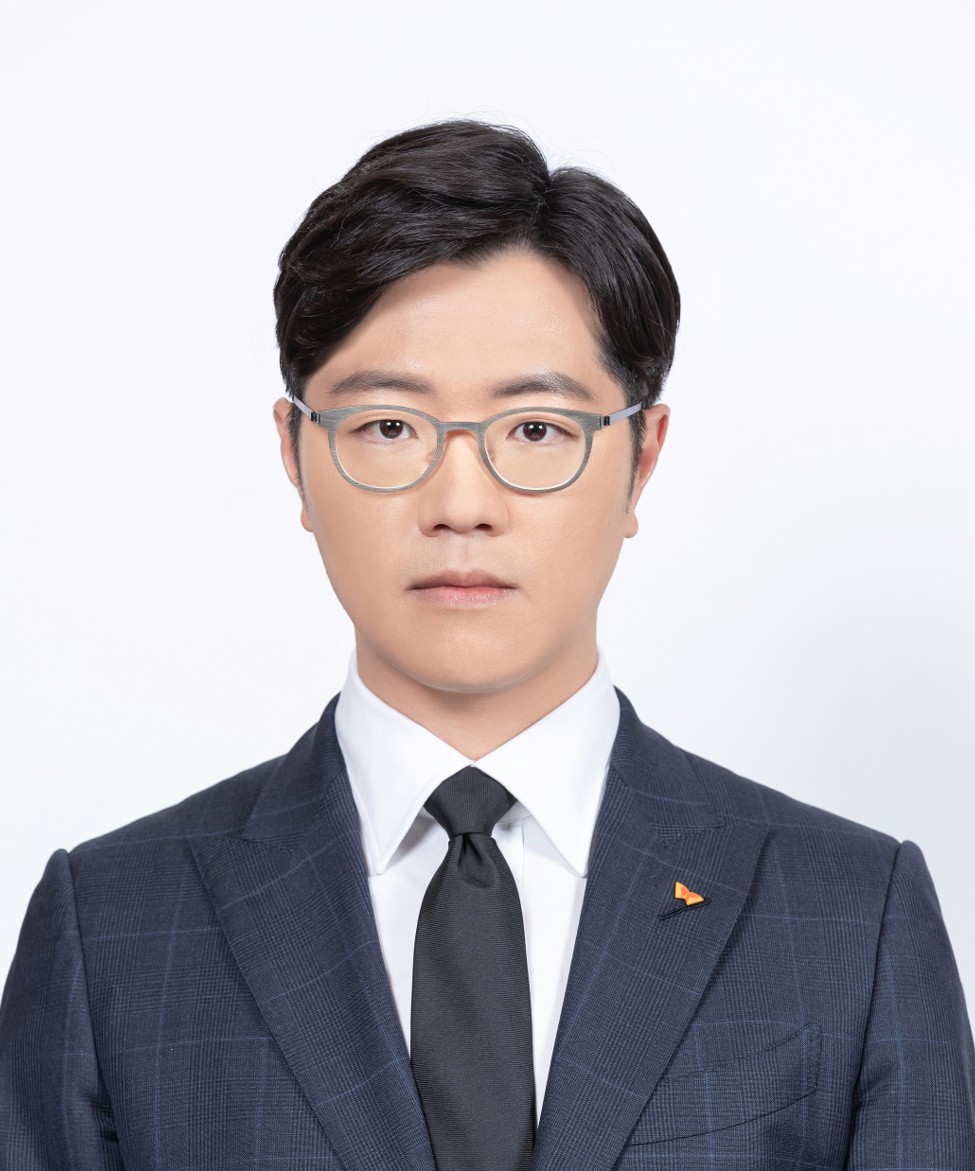
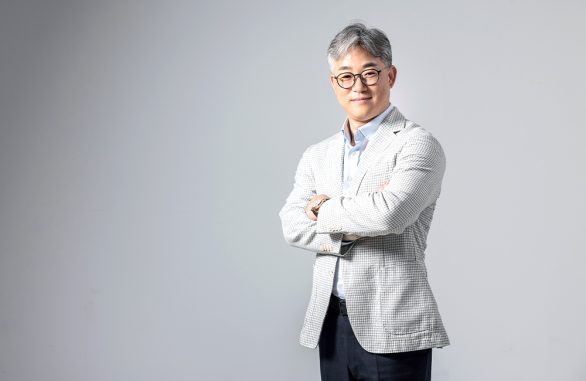
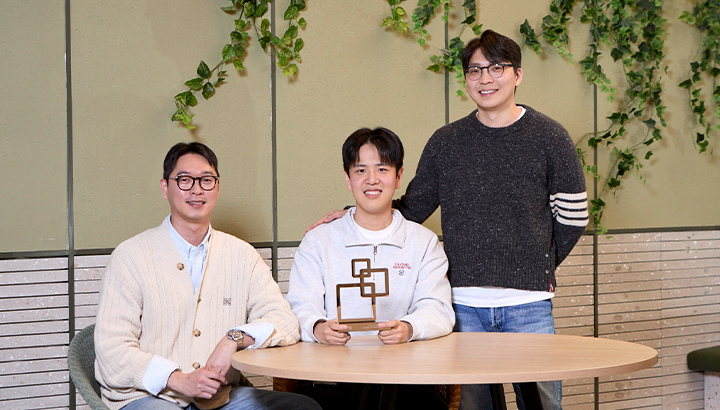
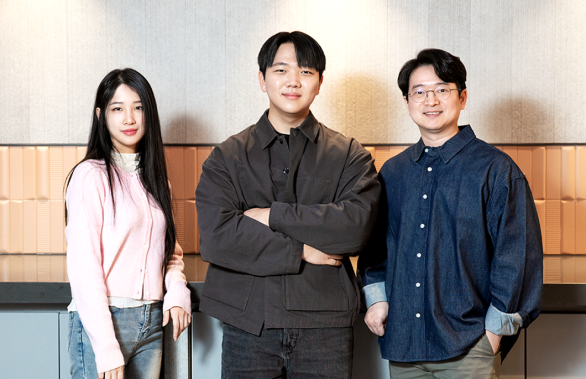
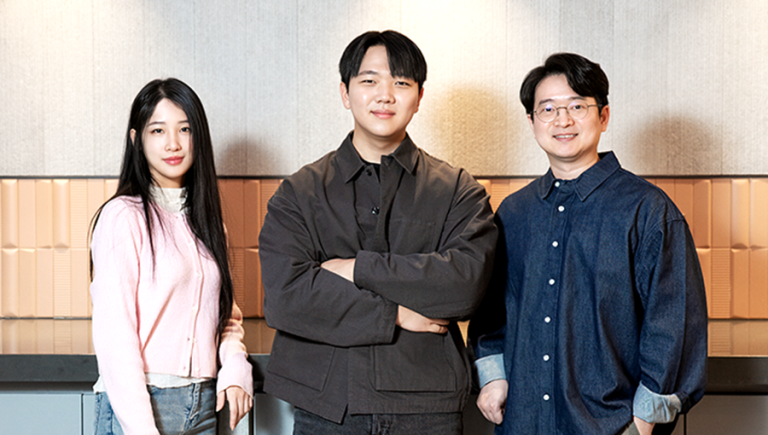
Yoo Kyung-sang, Head of AI CIC at SKT
The center of gravity in the AI race is expanding fast. While the race among frontier models to build bigger models, harness greater compute, and achieve higher levels of reasoning remains as fierce as ever, a new dimension is now shaping AI competitiveness: how efficiently that intelligence is deployed, how effectively it is translated into solving real-world problems and driving execution, and how well real-world experience and data are fed back to advance the next generation of models.
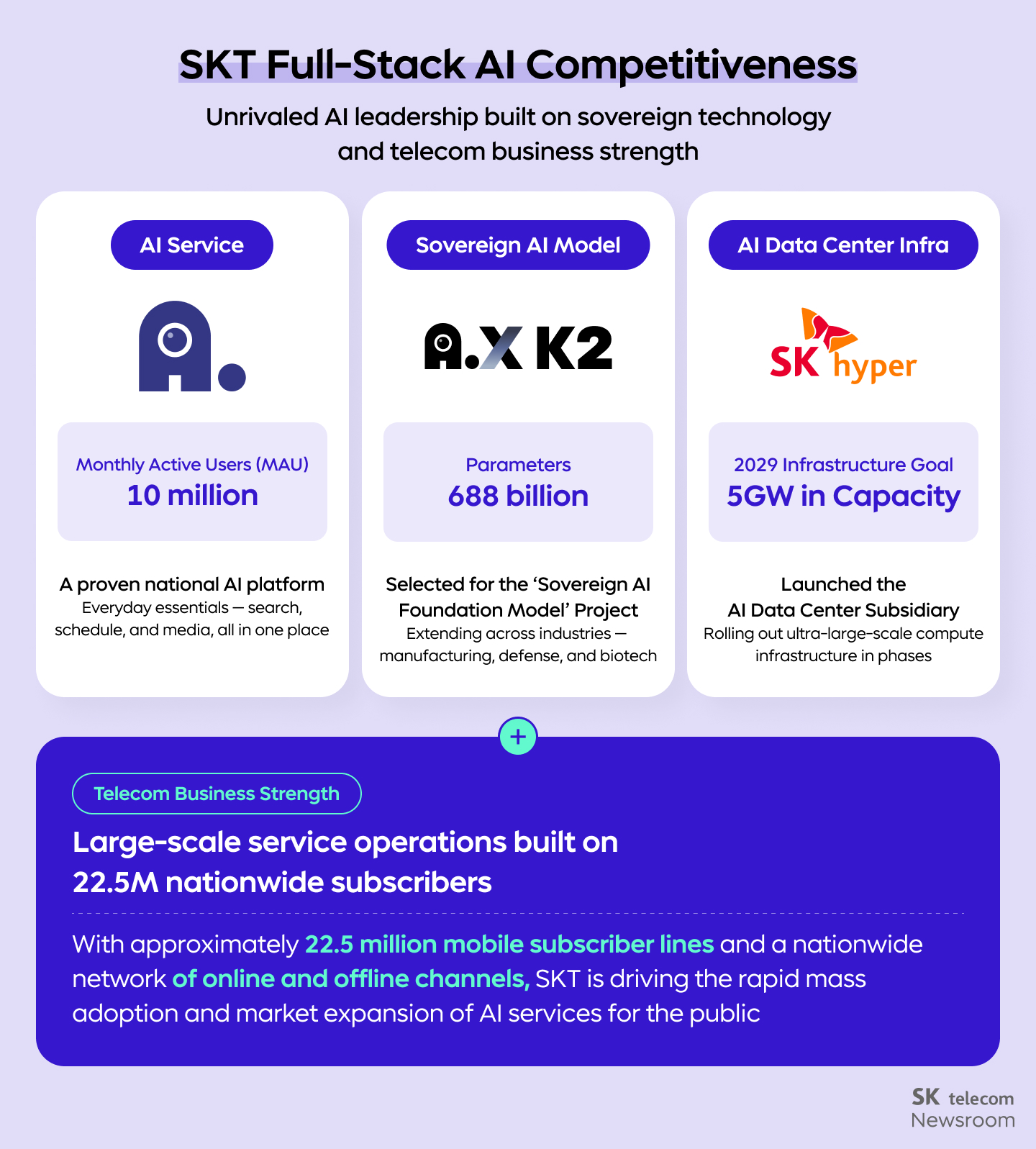
Model development and research remain the starting point of the AI race. SKT recently unveiled its proprietary AI model A.X K2, with 688 billion parameters, and successfully advanced to the third stage of the Korean government’s Sovereign AI Foundation Model Project.
With this achievement comes greater responsibility. SKT will not compromise on either technical performance or real-world practicality.
The reason SKT is focused on model development is clear: only by building top-tier intelligence in-house can a company chart its own technological direction — and the capabilities gained along the way can then extend into lightweight, specialized models and industrial AI applications.
But possessing a strong model is one thing. Building and operating an AI service that tens of millions of people trust and use every day is an entirely different challenge.
Going forward, AI competitiveness will be difficult to define by model performance alone. A model’s intelligence, the economics of inference, the completeness of the service, the speed of retraining and improvement based on real-world data, and trust must all come together as a single, integrated system. If any one of these pillars is weak, even the most impressive technology risks remaining confined to the lab or an eye-catching demo.
Striving for world-class intelligence, and ensuring that intelligence is genuinely put to use by the public and across industries — with that experience feeding back into further technological advancement — are not two separate races. They are one and the same.
Building on the technology and service capabilities it has accumulated, SKT is now ready to expand into nationwide AI services that people can experience and use in their everyday lives. Its participation in the “AI for All” initiative marks the starting point of turning that vision into reality.
“Infrastructure – Model – Service”: SKT’s “AI for All” Delivers Economical Intelligence and a Rapid Improvement Loop
If model training raises the ceiling on the intelligence we can achieve, inference technology determines how broadly and how economically that intelligence can be put to use. This is not an either-or choice. That is why SKT has continuously advanced its proprietary A.X model while simultaneously working to make it genuinely useful across real industries and services.
SKT’s A.X K2 is a large-scale foundation model built on 688 billion parameters — but processing every request at maximum model capacity is not sustainable in an environment where millions of users interact with the service simultaneously. Moreover, while technological progress continues to drive down the cost per token, the workloads being delegated to AI are growing heavier even faster.
As handling long context windows, running multiple attempts and tool calls, and coordinating collaboration among multiple agents become everyday occurrences, the economics of inference become an increasingly difficult problem to solve. SKT’s approach brings together a Mixture of Experts (MoE) architecture that selectively activates only a portion of the model’s total parameters for each request; a reasoning method that adjusts the depth of thought according to the difficulty of the question; lightweighting and acceleration techniques that boost serving efficiency while preserving output quality; and an operational structure in which lightweight models instantly handle simple queries while larger models perform deep reasoning on complex tasks. Together, these elements are designed to decouple the “scale” of intelligence from its “cost,” ensuring economic sustainability even at a nationwide scale.
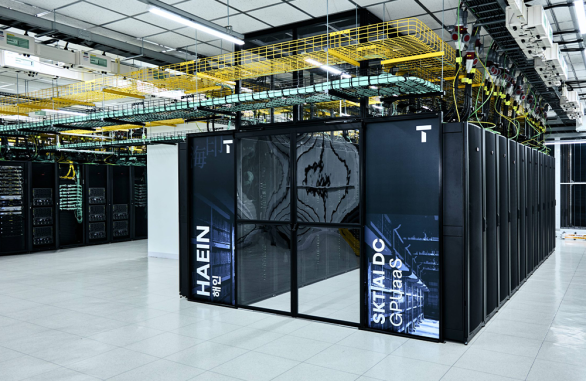
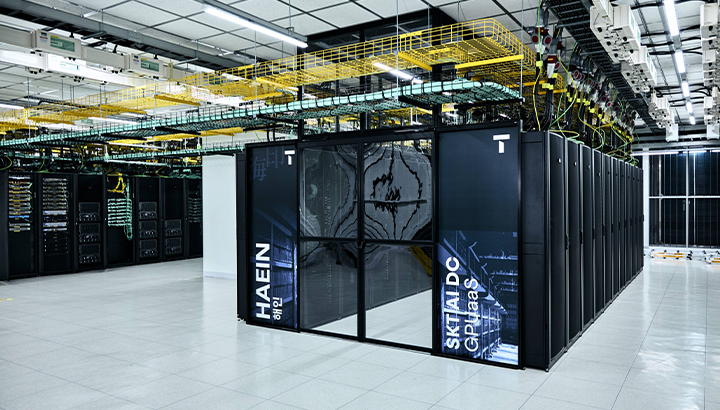
True optimization is completed only when these algorithmic-level refinements are paired with system- and semiconductor-level work — including memory hierarchy management and compute resource allocation. This is precisely why SKT, which designs and operates its own AI infrastructure, is able to pursue inference economics to its fullest extent.
Viewed from this perspective, A.X K2’s advancement to the third phase of the Sovereign AI Foundation Model Project carries significance well beyond technical benchmarks or reputation — it reflects recognition, from the perspective of experts and real users alike, of the model’s field-level applicability and practical value. A.X K2 has already been deployed across SK Group’s internal businesses and services, as well as external sectors including defense, manufacturing, legal, and tax — earning recognition for its practical utility along the way.
What SKT values most is the speed of improvement. AI’s competitive edge is not determined by a single round of training. Competitiveness comes from how quickly a company can identify where the model fails in real-world use, translate those failures into evaluation criteria and training signals, and then improve the model, inference, and service before redeploying it to users — repeating that cycle as rapidly as possible.
As a well-designed loop accumulates model performance data and insight into user context, AI ceases to be a fixed product built once and left unchanged — it becomes a system that adapts to each user and evolves through use. The experience and data gathered in this process feed directly into training the next generation of models, increasingly blurring the boundary between training and inference.
Ultimately, the AI competition of the future will not be about building the single best model once — it will be about building the fastest loop for improving intelligence.
This is why SKT considers the combination of its full-stack AI capabilities — spanning service, model, and infrastructure — with its large-scale service operation experience as a telecommunications provider to be its greatest competitive strength, achieved through complete vertical integration.
The true value of this structure lies not in simply owning these assets, but in the ability to run the improvement loop faster than anyone else: lowering cost and latency at the infrastructure level, improving inference quality at the model level, and feeding insights discovered through the service back into the model and system.
The proof that this loop is already working lies in SKT’s hands-on experience: having directly planned and launched “A.”, an AI service that has surpassed 10 million monthly active users, and having continuously advanced it based on real user feedback.
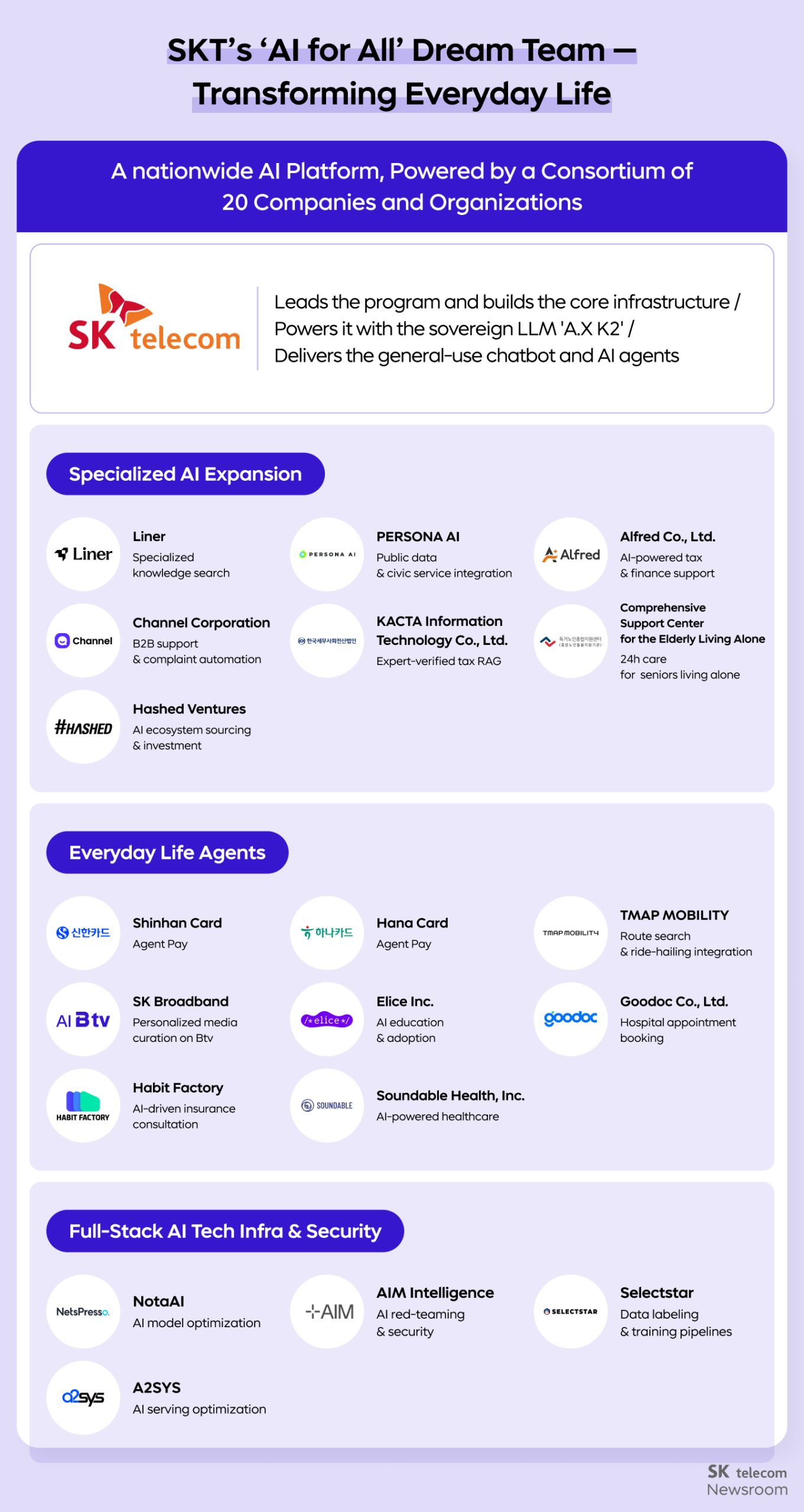
A Dream Team of 20 Companies, Expanding Through MOUs with 11 More: Building Korea’s AI Ecosystem
The next stage for AI services is clear: moving beyond AI that simply “answers” questions to AI that “executes tasks and delivers results” on the user’s behalf. The success of AI for All, too, should be measured not by the number of conversations, but by the number of tasks completed.
In the age of agentic AI, service quality can no longer be explained by the accuracy of an individual model’s answers alone. Because the process spans multiple stages — planning, search, tool calls, and execution — even small errors can compound along the way.
What matters is not the accuracy of a single model response, but the end-to-end success rate: whether a user’s intent actually translates into a real-world outcome. In other words, even when agents use the same underlying model, the level of work they can actually accomplish varies significantly depending on what they remember, what permissions they are granted, which tools they can operate, and how well they recover from failure.
This is precisely why becoming an AI that executes — not just responds — requires deep domain expertise in each field where the service is delivered, in addition to AI technology itself.
Each domain — financial regulation, healthcare data, tax systems — carries context that only specialized companies with long-standing experience in that field truly understand. No single company, building everything in-house, can meet the full diversity of needs in people’s everyday lives.
This is why SKT has formed a consortium with leading companies and technology specialists across finance, mobility, media, education, healthcare, public services, tax, and caregiving.
Within this consortium, SKT’s role is not to build every service itself, but to act as a trusted orchestrator* — connecting the public’s intent to the most suitable models, technologies, and specialized services.
* A system that analyzes user requests and selects and connects the optimal AI models and technologies.
“AI for All,” the initiative SKT is driving, is not simply a chatbot service — it is a proving ground where Korea’s AI models and services meet the public.
The initiative will begin in everyday domains people engage with daily — finance, mobility, media, education, and health — before expanding into specialized areas such as tax, administrative services, and caregiving that are essential to specific groups, including young people, small business owners, and seniors. SKT will also pay close attention to vulnerable populations less familiar with digital services, ensuring that gaps in AI access do not become new social divides — so that every citizen can use AI as conveniently and naturally as possible.
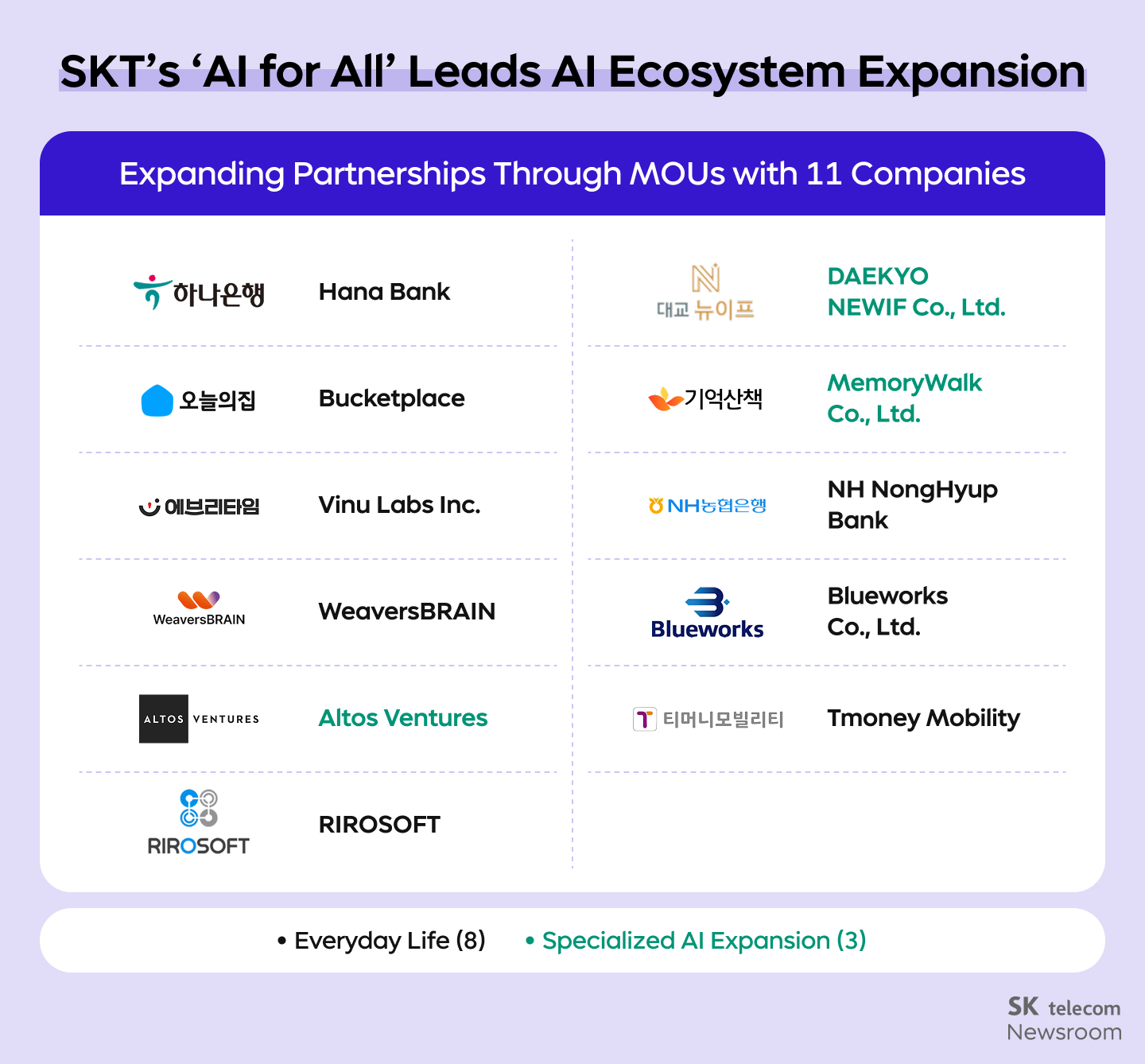
The SKT consortium — comprising SKT and roughly 20 partner companies, institutions, and organizations — is merely the starting point of this ecosystem. Having signed MOUs with 11 additional companies, ** the consortium will continue building an open AI ecosystem that welcomes companies and institutions bringing new technologies and expertise.
** Hana Bank, Bucketplace, Vinu Labs Inc., WeaversBRAIN, Altos Ventures, RIROSOFT, DAEKYO NEWIF Co., Ltd., MemoryWalk Co.,Ltd, NH NongHyup Bank, Blueworks Co.,Ltd, and Tmoney Mobility.
“Beyond Performance, Toward Trust”: An Everyday Tool the Public Can Use with Confidence
As AI becomes more deeply integrated into people’s lives and the execution of essential services, the foremost priority that must be guaranteed is trust. Trust, however, should not be defined as “the complete absence of risk” but rather as “the capability to manage risk.”
The essence of responsible AI operation lies in the ability to continuously identify risks, contain their scope of impact, recover quickly when issues arise, and improve systems so the same errors do not recur.
SKT is building an environment that everyone can use with confidence — leveraging model optimization and inference acceleration technology to ensure fast, responsive performance, while continuously managing risk through objective evaluation of AI model quality, ongoing AI red-teaming, real-time safety monitoring, and guardrails, alongside a security system designed to safely handle personal and sensitive information.
Korea must now move beyond being “a country that uses AI well” to becoming “a country that can independently choose the future direction of AI.” That power of choice comes from the very cycle described above.
It means striving for world-class intelligence, spreading that intelligence across the public and industry, and ensuring that the loop of improving intelligence — turning real-world experience and data into the technology of the next generation — keeps turning within Korea itself.
“AI for All” is both the tool that starts this virtuous cycle in people’s everyday lives, and the first stage where every citizen can experience the value of that cycle firsthand.
By connecting the technological strength of A.X K2, the nation’s largest AI infrastructure, the operational experience gained from serving 10 million users of “A.”, and the expertise of partners across every sector, SKT will build “everyday AI” that everyone can use with ease — while laying the foundation for Korea’s next challenge in AI.