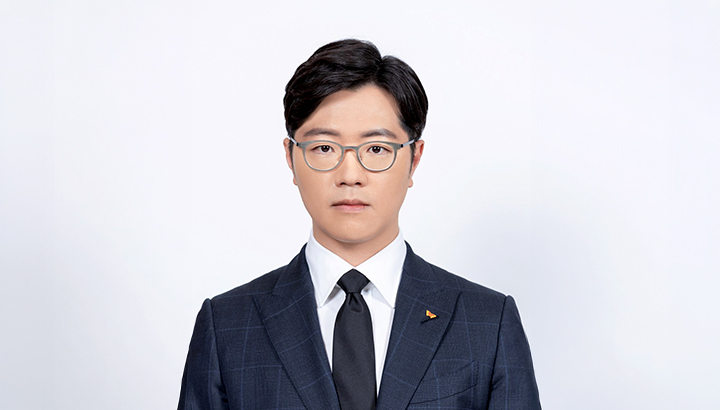
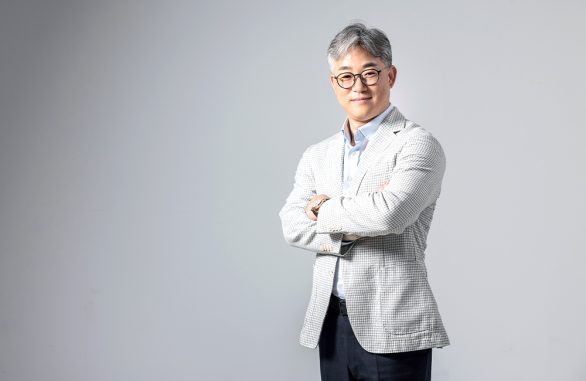
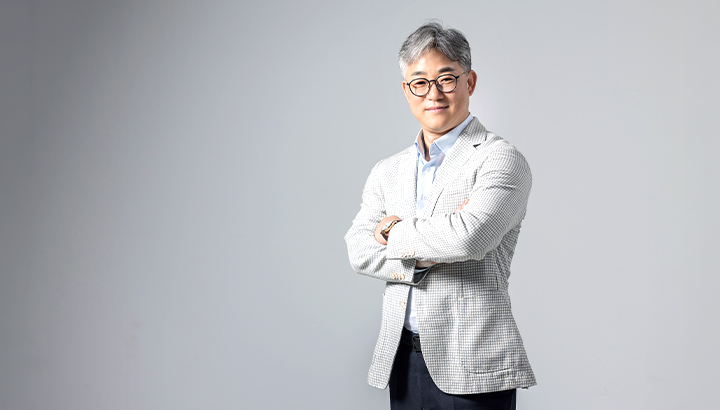
Yang Seung-hyun, Head of the AI R&D Center (CTO), shares insights from leading SK Telecom’s “Sovereign AI Foundation Model” Project. In this column, he shares how SKT has built its AI capabilities over the years, the current state of project preparation, and the company’s commitment to driving this national initiative forward.
On August 4, the SK Telecom-led consortium was designated by the Ministry of Science and ICT (MSIT) as the core team for the Sovereign AI Foundation Model Project. Often referred to as the “National AI Project” within the industry, this initiative marks a historic step for South Korea to assert AI sovereignty and secure its industrial competitiveness amid fierce global competition led by the U.S. and China. For SKT, to be part of this journey is both a profound honor and a great responsibility.
The Heavy Responsibility of Being a “K-AI Company” Driving Korea’s AI Future
This project represents much more than a research project. Selected teams receive the designation of K-AI Company from the government – a recognition by the state as Korea’s AI representatives. This title brings with it the responsibility to help lead Korea’s sovereign AI efforts and contribute across the AI value chain – from models and infrastructure to services. Under the K-AI banner, the models and services we build will prioritize accessibility and inclusiveness, serving the public while fostering ecosystems and industrial growth.

The SK Telecom consortium aims to develop the next generation of large-scale omni-modal AI models that go beyond language. By integrating text, speech, images, video, and even agent-driven actions, the K-AI model seeks to open a new paradigm of AI that can interact with humans more naturally. Our vision is to move from answering questions to reasoning, planning, executing, and solving complex challenges step by step. It will eventually evolve into an intelligent AI agent used broadly across demographics such as students, professionals, and senior citizens in their daily lives.
We are setting ambitious goals from a technology perspective: building ultra-large models with hundreds of billions to trillions of parameters, trained on trillions of tokens and implementing the state-of-the-art Mixture of Experts (MoE)A mechanism where multiple specialized smaller expert models tackle different input types based on expertise, selecting the most suitable expert model for each input to solve a larger issue. architecture to optimize training efficiency. We will go beyond our existing A.X series models, designing and training a completely new model from scratch, to achieve at least 95% of the performance of global frontier models, and ultimately develop a proprietary post-transformer model that can rival the world’s best in both performance and efficiency.”
Tackling the Grand Challenges of Large-Scale AI with the “Pyramid Strategy” based on “Self-Reliance” and “Collaboration”
What makes such a bold challenge possible is our AI Pyramid Strategy built on self-reliance and collaboration.
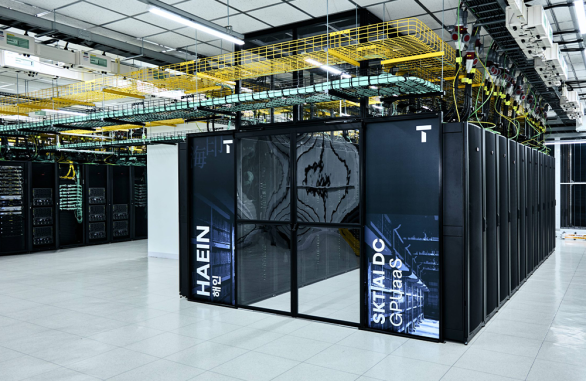
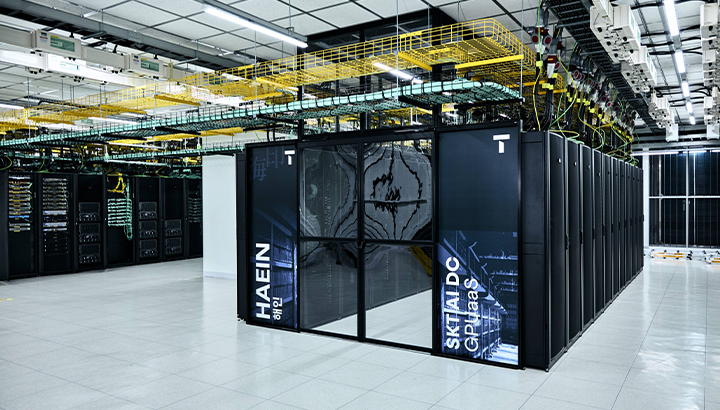
On one hand, we draw strength from SK Telecom’s accumulated assets: being the first in Korea to develop and release large language models; operating TITAN, the nation’s fifth-largest supercomputer; building GPU clusters and MLOpsTechnologies and processes for efficiently developing and operating machine learning models, which simplify data processing, model training, deployment, and monitoring through automation. capabilities; constructing the upcoming Ulsan AI Data Center; and commercializing in-house models across millions of daily call summaries and customer consultations.
On the other hand, the consortium brings together leading companies such as Krafton, 42dot, Rebellions, Selectstar, and Liner, alongside top researchers from Seoul National University and KAIST. Together, spanning industries from gaming and automotive to semiconductors, data, and multimodal AI, we will tackle the grand challenges of large-scale AI.
The impact of this project will extend far beyond technical achievement. Our initial plan is to apply and expand the model within the SK Group and among consortium partners. Already, more than 20 organizations – including SK hynix, SK Innovation, SK AX, SK Broadband, the Chey Institute for Advanced Studies, and the Korea Foundation for Advanced Studies – have submitted letters of intent to deploy and validate the model in real-world settings. This will lay the groundwork for leading AI transformation across industries such as manufacturing, automotive, gaming, robotics, finance, and more.
Our ambitions extend beyond domestic adoption to global expansion. The K-AI model will support Korean, English, and many more languages imbued with native contextual understanding and global relevance, positioning Korean AI not as a follower, but as a competitor in the global arena.
More than an AI Model: Securing Korea’s AI Sovereignty
There is still a long way to go. The project will undergo rigorous evaluations every six months, with only two teams advancing to the end. The first checkpoint will be in December, requiring us to prove 95% of global frontier performance in under three months. This is a daunting race, but we are ready to prove our competitiveness through SK Telecom’s accumulated expertise, determination, and execution.
Ultimately, this project is not simply about creating a new AI model. It is about securing Korea’s AI sovereignty, building the foundation of industries for the next 10 to 20 years, and delivering AI that is accessible to everyone, transformative across industries, and competitive on the world stage.
This is not only SKT’s challenge. It is Korea’s collective effort to rise as one of the world’s top three AI powers.