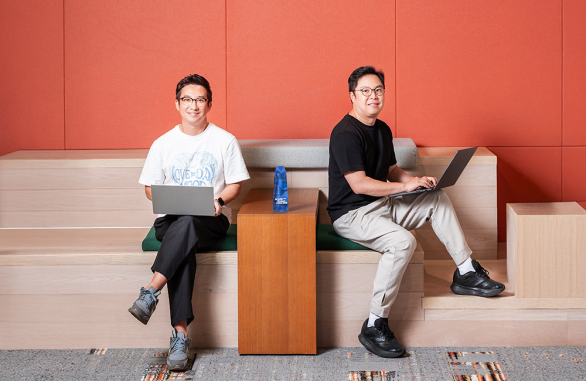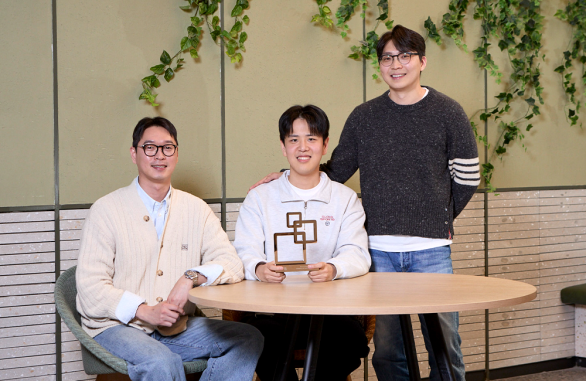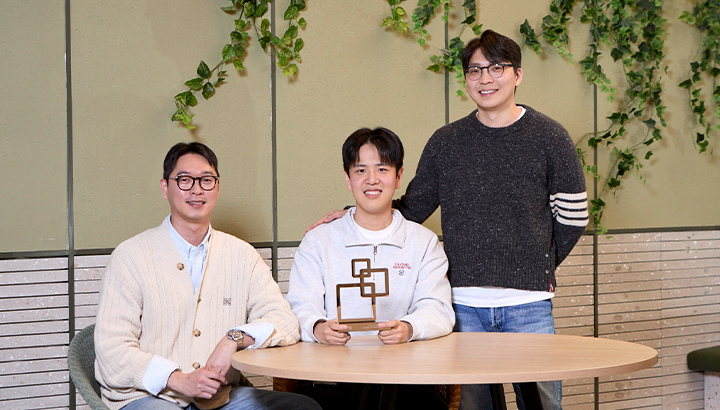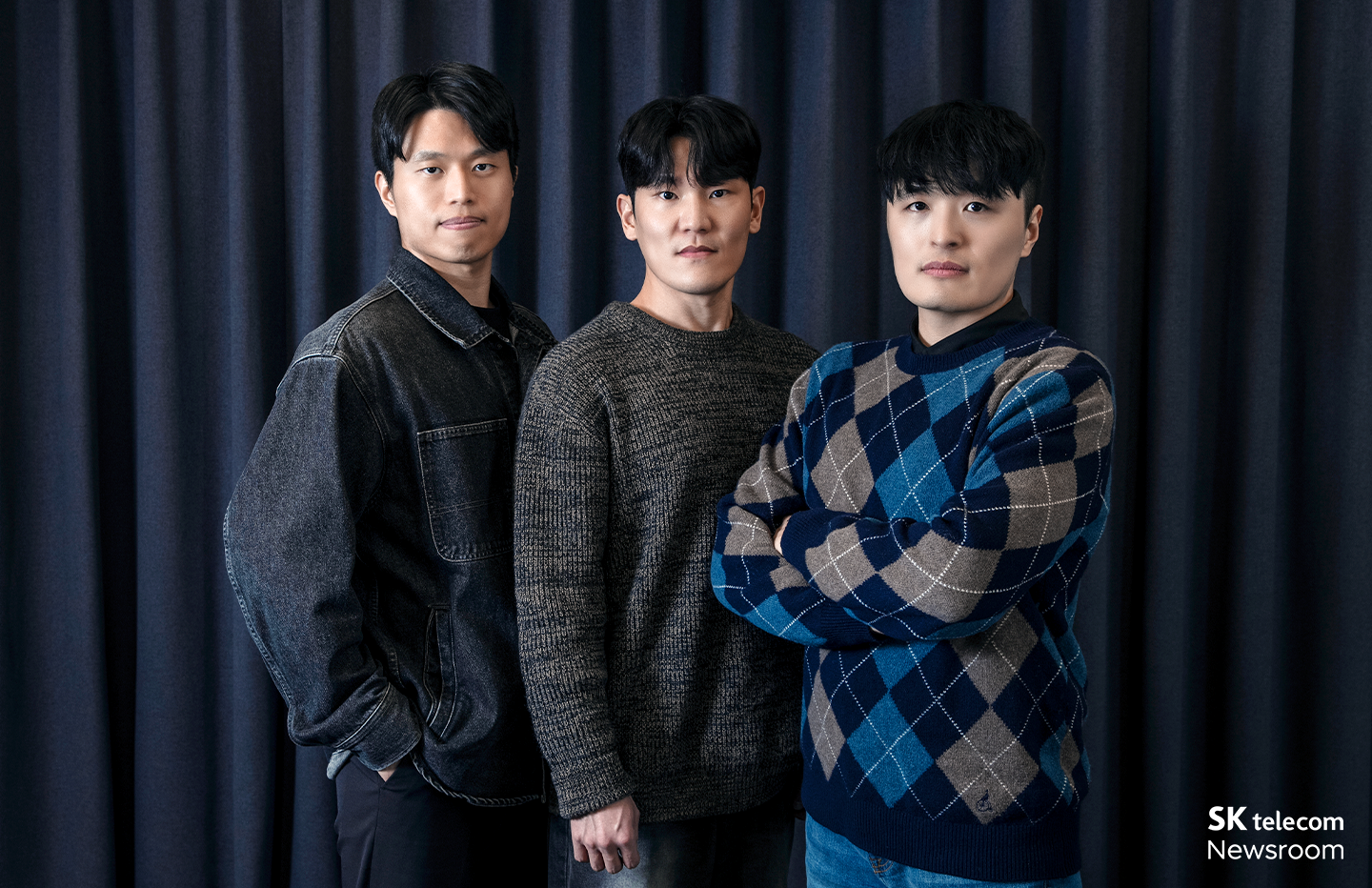
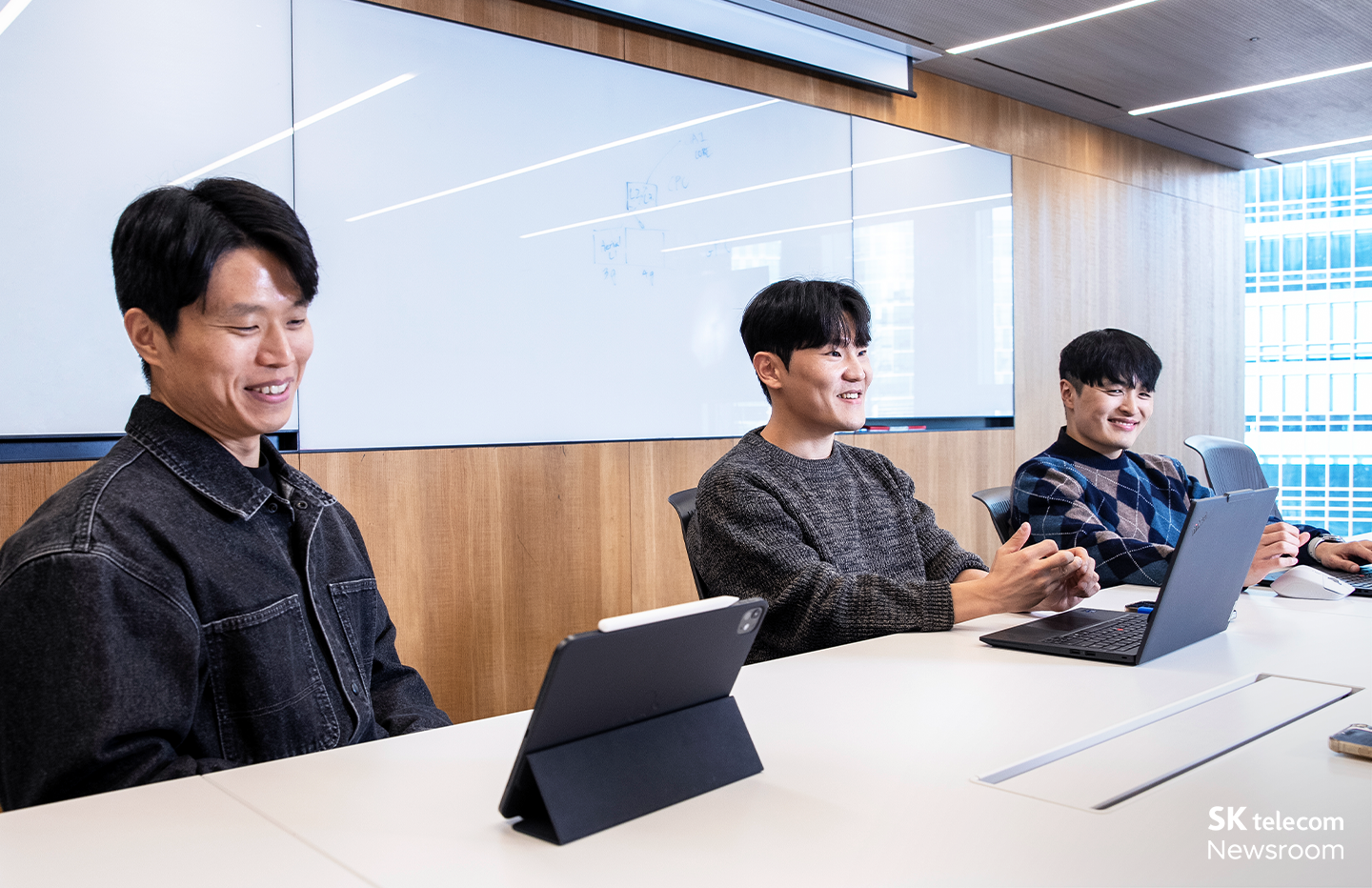
(From Left) Oh Tae-seok, Lee Kyung-pil, Jung Sang-min of 6G Tech Team
Mobile communications have evolved on roughly 10-year cycles and are now moving beyond 5G toward the era of 6G. Built on AI embedded across all areas of mobile communications, 6G technology heralds not a simple generational shift but a transformation into intelligent networks. What will a network that combines 6G and AI look like? We spoke with Lee Kyung-pil, Jung Sang-min, and Oh Tae-seok of the 6G Tech Team about the future direction of mobile communications shaped by 6G and AI, as SKT has won the Minister of Science and ICT Award at the Radio Wave Broadcasting Technology Awards for four consecutive years.
6G and AI, Two Pillars Shaping the Future
Q1. Please introduce your team.
A. Lee Kyung-pil: As the name suggests, 6G Tech Team is a research team that aims to commercialize 6G, the next generation of mobile communications technology, by proactively identifying and developing core technologies. Our research areas are broadly divided into two pillars: Network AI and 6G mobile communications technologies.
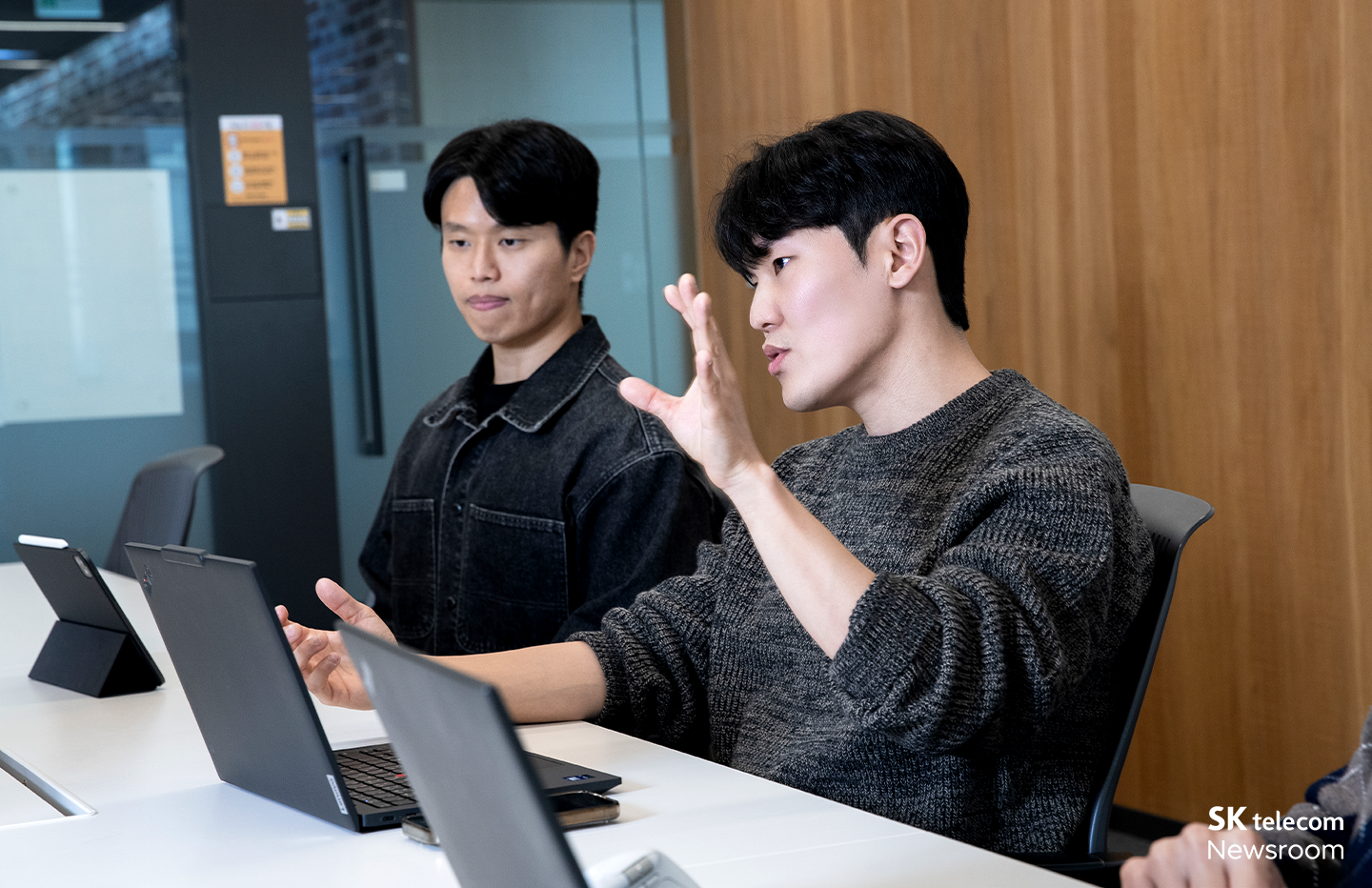
Lee Kyung-pil of 6G Tech Team
Network AI refers to research that combines mobile networks and AI, and it takes two directions. One is using AI to make the network itself smarter and more efficient (AI for Network). The other is evolving the network so that it serves as a foundational platform for delivering AI services (Network for AI).
The fundamental advancement of the 6G mobile communications technologies, the second pillar, encompasses a wide range of research areas. It includes the use of new frequency bands, technologies to improve radio resource efficiency, sensing using mobile communications radio waves, satellite communications technologies that organically connect satellite and terrestrial networks, and enhanced network security. Simply put, the team is working to make future networks smarter while preparing next-generation mobile communications technologies.
Q2. 6G and AI-RAN are key concepts driving next-generation mobile communications. What differentiates them from 5G and how does 6G connect with AI-RAN?
A. Jung Sang-min: 6G is the next generation of mobile communications technology following 5G, and our team is currently driving its R&D and standardization with a target timeline of around 2030. We define 6G not simply as a boost in transmission speed, but as a ‘future communication framework’ that integrates people, objects, spaces, and intelligence (AI) into a single, unified network.
On the other hand, AI-RAN is a next-generation mobile network technology that applies AI to the radio access network (RAN). If the mobile network is compared to a nationwide highway system, the RAN represents the local access routes that our smartphones directly interface with. AI-RAN is a core technology that adds AI-driven intelligence to these routes, RAN, to optimize communication quality and stands as a core technology that empowers base stations to provide advanced AI services alongside traditional connectivity.

Jung Sang-min of 6G Tech Team
A. Oh Tae-seok: The generations of mobile communications have evolved on roughly ten-year cycles. While 6G is a continuation of this trajectory, the key difference is that AI is being integrated across all areas of mobile network, accelerating its evolution. 6G and AI-RAN technologies are currently being developed in parallel, and we are preparing with the vision that these two technologies will be organically combined into an “AI-native network” in the 6G era.
■ The Three Facets of AI-RAN: For, And, and On
AI for RAN: A perspective that applies AI to improve the performance, quality, and efficiency of networks. An example is technology that enables mobile communications without reference signals by allowing AI to learn the radio environments, thereby improving radio resource efficiency.
AI and RAN: A perspective that focuses on creating a platform that can provide AI services by adding computing power to networks. Going beyond the simple transmission of data, the network itself evolves into an infrastructure capable of performing AI computation.
AI on RAN: A perspective centered on actual operation of AI services on the mobile network. Demonstration and standardization efforts to evolve the network so that it can deliver AI services using the mobile infrastructure are key.
Four Consecutive Ministerial Awards, the Secret Behind the Innovation
Q3. SKT has won the Minister of Science and ICT Award at the Radio Wave Broadcasting Technology Awards for four consecutive years. In 2025, ‘6G AI-based Pilotless Communication’ drew particular attention. Could you explain what this technology is?
A. Lee Kyung-pil: Simply put, it is a technology that improves radio resource efficiency by accurately delivering data without relying on pre-defined reference signals. In conventional systems, the transmitter and receiver must continuously exchange agreed-upon reference signals in order to estimate the impacts of the radio environments while transmitting and receiving data. When data passes through radio environments, it’s difficult to know how it will be affected.
Reference signals are inserted continuously within the data stream, but transmitting these reference signals requires additional radio resources. The resources used to send reference signals cannot be used to transmit data, which reduces resource utilization efficiency.
The award-winning technology replaces the core transmit and receive signal-processing procedures of conventional systems with AI. By learning the radio environments, AI enables accurate data recovery even without reference signals. This overcomes the limitations of existing systems that required reference signals and allows radio resources to be used entirely for data transmission. As a result, limited resources can be utilized more efficiently, leading to a significant improvement in overall system performance.
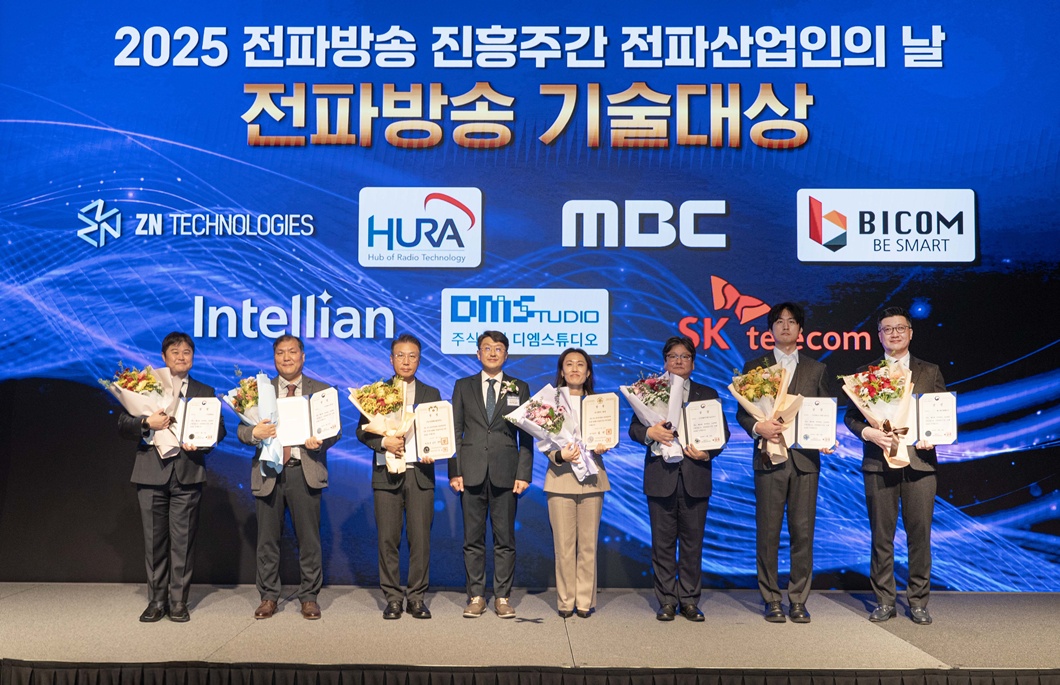
SKT won the Minister of Science and ICT Award at the 2025 Radio Wave Broadcasting Technology Awards for its AI-based wireless transmission and reception technology for next-generation 6G mobile communications.
“We drew inspiration from the similarities between conventional mobile communications systems and image processing. By treating signals as a two-dimensional image along the time and frequency axes, we achieved 6G AI-based Pilotless Communication using AI models widely adopted in the field of vision AI.” — Lee Kyung-pil
Q4. After laboratory verification in 2024, you succeeded in validating the technology in real-world environments just one year later in 2025. What do you think drove such fast achievements?
A. Lee Kyung-pil: I believe it was made possible due to three factors – technical capability, collaboration, and vision. Rather than remaining at just an academic research level, we are conducting advanced research with a focus on technologies that are viable for commercialization from an operator’s perspective. In the process of establishing benchmarks and producing results in areas with no answers, we were able to find faster paths by working closely with global partners such as NTT, NTT DOCOMO, and Nokia Bell Labs, shortening what would otherwise have been a long journey if pursued alone. Under the future-oriented vision of “the convergence of mobile communications and AI,” we constantly monitored trends in technological evolution and pursued consistent research, which allowed us to continue boldly taking on challenges.
Q5. In a situation where there is uncertainty, predicting and preparing for technologies that will be needed in the future is no easy task. What made this possible?
A. Jung Sang-min: I wouldn’t say we accurately predicted the future, but we continuously explored and validated a wide range of candidate technologies with a pioneering mindset and strong technical capabilities. In this process, we held on to the truly meaningful technologies and developed them to the very end. Even as we speak, the team is researching numerous future technologies, and we believe that one of them will once again deliver tangible results.
“We constantly narrow down and refine potential candidate technologies to find those that truly matter. In doing so, we encounter a wide range of technologies, and some of them eventually produce results that seem almost as if they had been predicted. We are striving to ensure that such technologies also emerge in the 6G era.” — Jung Sang-min
A. Oh Tae-seok: I agree. Because the future carries a great deal of uncertainty, we repeatedly go through cycles of exploration, validation, and filtering out technologies that make us say, “This is genuinely useful.” This is precisely how we prepare for the next generation of mobile networks
How 6G Will Transform Everyday Life
Q6. How will our daily lives change in the 6G era? What will be the most noticeable change for everyday users?
A. Oh Tae-seok: We anticipate two major changes. The first is the diversification of devices. Beyond smartphones, a wide range of devices will be connected to mobile networks, including XR devices, robots, autonomous vehicles, and many others that consumers may not even be aware of.
The second is the experience of AI within the network. While this is not a perfect analogy, many AI services that users currently experience through apps will be delivered through AI provided directly by the network itself in the future. That said, we are careful not to become caught up in flashy blueprints and instead focus on delivering tangible, practical value.
A. Lee Kyung-pil: We are taking a realistic but innovative approach to 6G. Our goal is to provide stable, high-quality services that users can truly experience.
Q7. Physical AI has recently become a major topic. Why is 6G mobile communications important in the era of physical AI?
A. Jung Sang-min: As AI expands into agentic AI and physical AI, massive amounts of data need to be used continuously, and it is essential to have much higher reliability and ultra-low latency. While mistakes made by chatbots may end as minor glitch, errors involving physical AI used in robots or autonomous vehicles can lead to actual physical accidents. This is why extremely high reliability and ultra-low-latency mobile communications for instantaneous response are critical. 6G is being engineered specifically to satisfy these requirements.
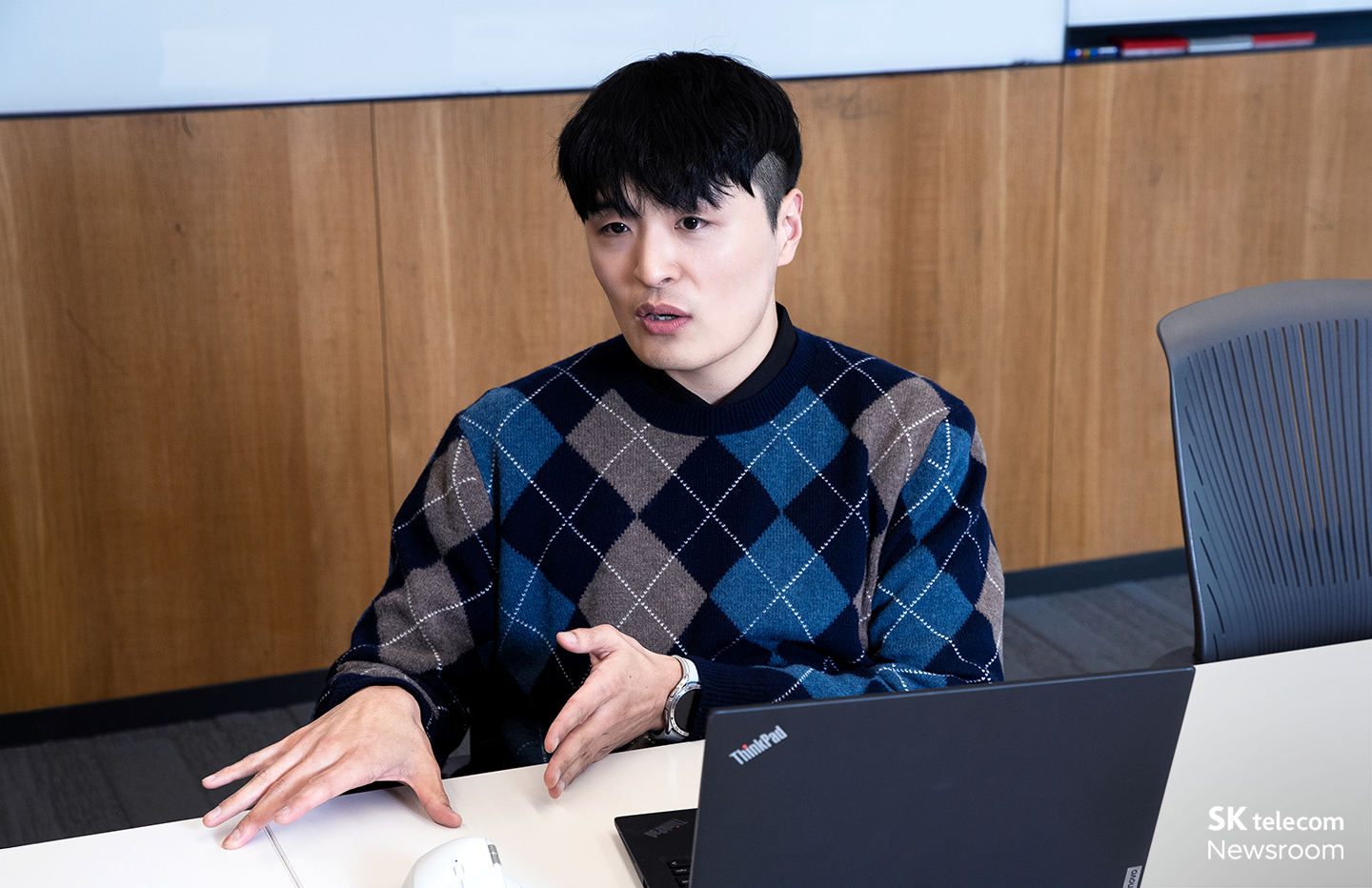
Jung Sang-min of the 6G Tech Team
A. Oh Tae-seok: Robots and autonomous vehicles can make decisions on their own, but offloading* AI computation to the network offers significant advantages, such as improved battery efficiency and lower device costs. That also means the core performance of mobile communications, including latency and reliability, must improve accordingly.
* Offloading (computational offloading): A method in which AI computations performed by robots or autonomous vehicle devices are transmitted to an edge server for processing, with only the results sent back to the device.
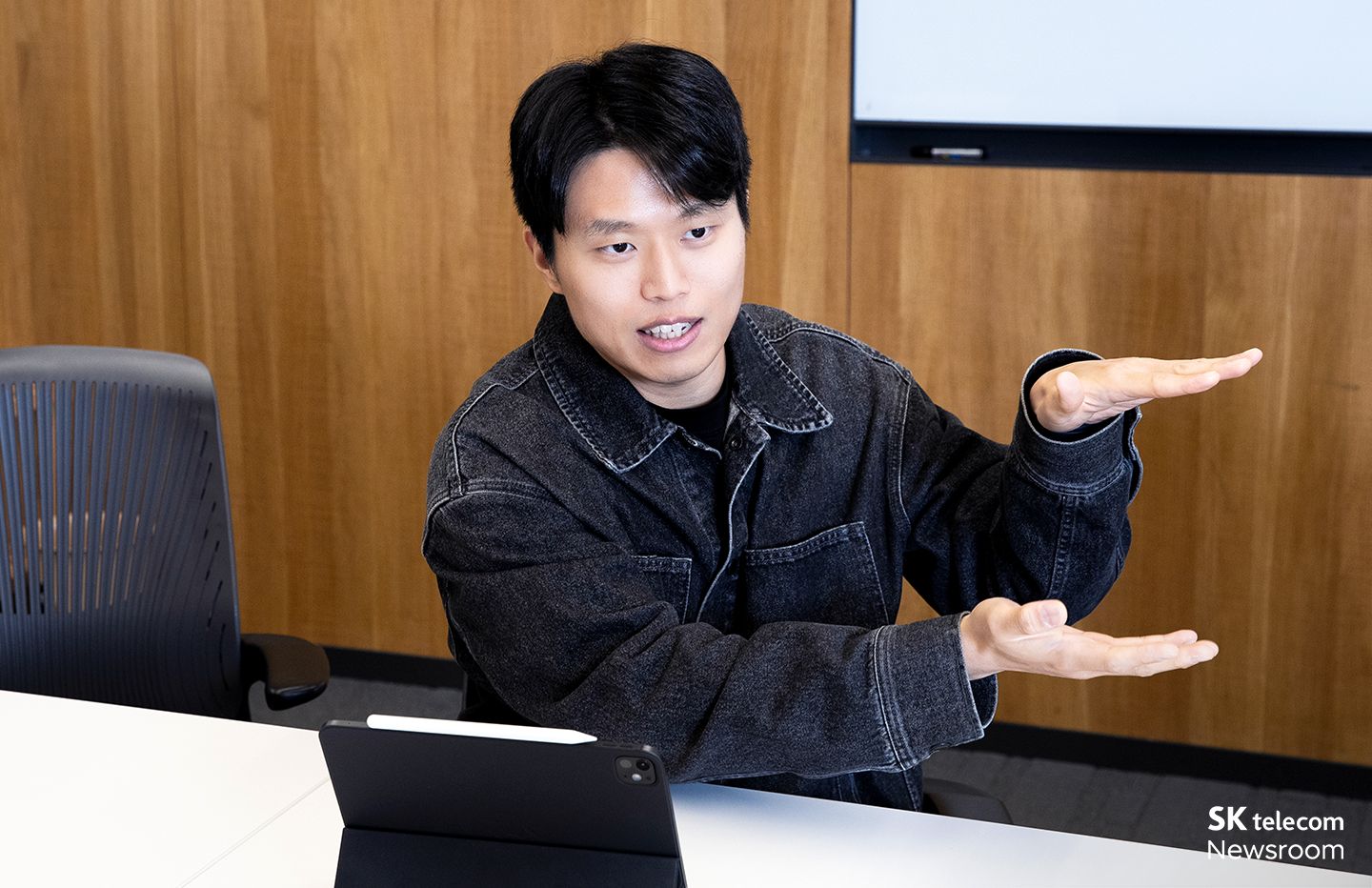
Oh Tae-seok of 6G Tech Team
Exploring, Challenging, and Learning: The Growth DNA of the 6G Tech Team
Q8. Developing technologies that have never been attempted before must have inevitably involved many obstacles. What moment stands out most in your memory?
A. Lee Kyung-pil: When technologies that worked well in the laboratory behaved differently from what we expected in real-world environments, it was difficult to identify the causes because there were simply too many variables. Radio environments are heavily affected by constantly changing surroundings and interference, and building initial test environments based on prototype equipment was difficult, which led to many trials and errors.
When we stabilized the environments and validated the value of the technology through systematic experiments, we felt a strong sense of accomplishment. It also gave us confidence that we had moved a step closer to commercialization. Once we advance the technology to a commercial level, the uncertainties inherent in the prototype stage will be significantly reduced.
Q9. Does 6G Tech Team have a unique research culture or collaboration style?
A. Jung Sang-min: It comes down to three things: effective communication, mutual learning, and proactive sharing.
We are a team of experts from various backgrounds. Because of that, we have a culture where we continue to ask questions and learn, even in domain outside our own areas of expertise. We can rapidly validate ideas and even if there is a bit of trial and error, we always learn from it. We operate in small, project-based units and frequently hold sharing sessions to exchange insights, which sometimes become a turning point that reshapes the overall direction of the team.
A. Oh Tae-seok: This culture formed naturally due to how broad each person’s scope of work is. We are agile in our exploration and open to learning which we quickly found is the way for diverse experts to move forward together.
A. Lee Kyung-pil: It is also crucial that all team members embrace the new without fear, possessing a spirit of challenge and agility. I believe this is the driving force that allows experts from diverse backgrounds to communicate openly and create synergy.
“Our team must be willing to embrace uncertainty on the journey toward 6G. We will take on many challenges, remain resilient, and ultimately present the optimal solutions.” — Oh Tae-seok
In 2026, the 6G Tech Team will continue to deepen its research, aiming for an evolution toward an “AI-native network.” Moving beyond simply validating technological feasibility, the team will expand its scope by exploring what can be achieved with these technologies. In the hardware domain, the team will continue to explore the potential of various AI chips (xPUs) beyond GPUs, identifying the optimal combination for commercialization.
True to their pledge to “do our utmost so that customers can be the first to experience new values beyond their expectations,” the 6G Tech Team has already embarked on its journey of innovation. Built on a fearless spirit of challenge and a culture of sharing knowledge, the team will continue its journey toward global leadership in 6G mobile communications era, reaching beyond Korea to the world.